
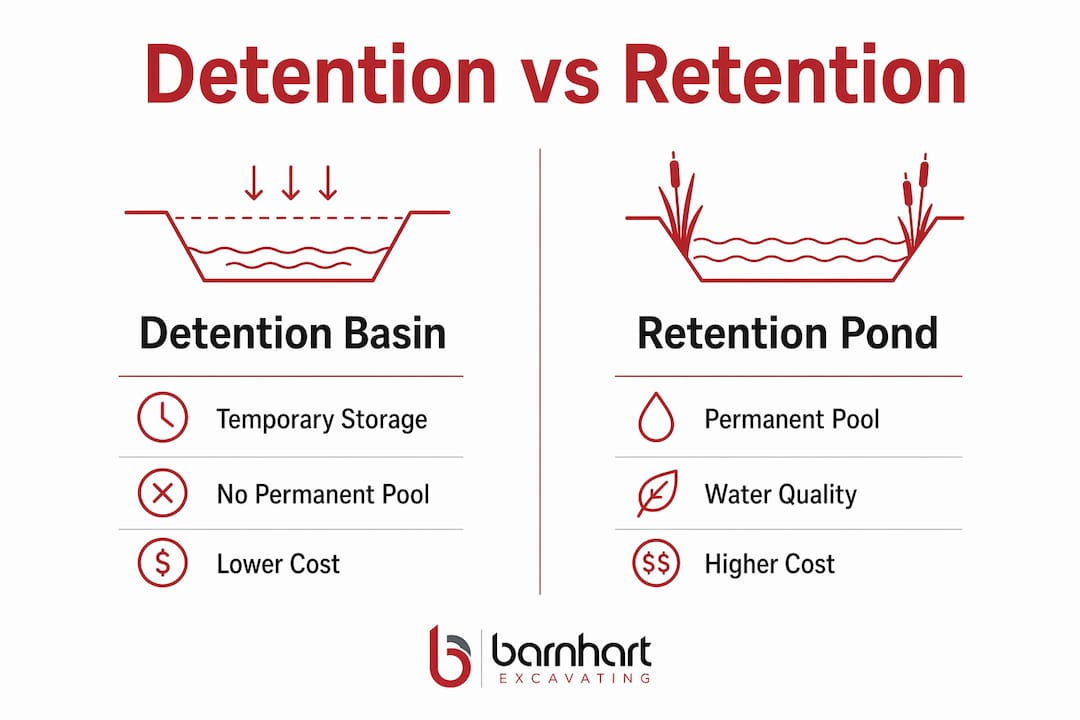
A detention pond temporarily stores stormwater and releases it at a controlled rate through an outlet orifice, while a retention pond maintains a permanent pool year-round and treats runoff through sedimentation and biological uptake before any overflow occurs. That single structural difference, permanent pool versus no permanent pool, drives every design, cost, and maintenance decision that follows.
The core rule: If your site needs peak-flow control and land is limited, start with detention. If your AHJ requires pollutant removal or nutrient credits, plan for retention. Confirm which requirement governs before you size anything.
Two immediate action items before you go further:
-
Confirm your AHJ’s priorities. Ask whether the permit requires water-quality volume (WQv) credits, peak-flow attenuation, or both. EPA stormwater guidance and state DOT manuals each set different thresholds, and local requirements often exceed federal minimums.
-
Flag your site footprint and maintenance capacity. Retention ponds typically require 2–7× more permanent volume than extended detention basins. If long-term dredging and vegetation management are not in your budget, that changes the calculus immediately.
Table of Contents
-
How detention (dry) basins work: components, performance, and trade-offs
-
How retention (wet) ponds work: treatment mechanisms and design considerations
-
Design trade-offs: cost, pollutant removal, safety, and footprint
-
Regulatory and AHJ design checkpoints you need to confirm early
-
A contractor’s perspective on what actually goes wrong in the field
-
Barnhart Excavating: experienced pond excavation and site grading from the ground up
Detention vs retention pond: quick comparison at a glance
The table below covers the seven dimensions that matter most when you are choosing between these two stormwater management ponds.
| Dimension | Detention (Dry) Basin | Retention (Wet) Pond |
|---|---|---|
| Permanent pool | No | Yes |
| Primary purpose | Peak-flow / flood control | Water quality + storage |
| Pollutant removal | Moderate (suspended solids) | High (suspended solids + dissolved nutrients) |
| Footprint | Smaller initial footprint | Larger; 2–7× more permanent volume |
| Construction cost | Lower | Higher (50–150% more) |
| Maintenance | Simpler; outlet-focused | More intensive; dredging, vegetation, mosquito control |
| Aesthetics / habitat | Dry between storms; limited habitat | Neighborhood amenity; wildlife habitat potential |
Decision rules of thumb:
-
Choose retention when nutrient removal is required, aesthetics matter, and you have the acreage and O&M budget.
-
Choose detention when peak-flow control is the primary goal, the site is space-constrained, and water-quality credits are not mandated.
-
Consider a wet extended detention (wet ED) or micropool ED variant when you need partial water-quality credit with a smaller permanent footprint than a full wet pond.
Pro Tip: The single most common reason a project flips from detention to retention is an AHJ water-quality credit requirement tied to a nutrient-impaired receiving water. Confirm this before schematic design, not after.
How detention (dry) basins work: components, performance, and trade-offs
A detention basin is designed to be dry between storm events. Runoff enters, fills the basin to a design elevation, and drains through a low-level outlet orifice at a controlled rate that limits downstream peak flows. Once the storm volume clears, the basin returns to dry ground.
Typical components:
-
Forebay: Upstream settling cell that captures coarse sediment before it reaches the main basin.
-
Outlet orifice / riser: Controls the release rate; sized to limit peak discharge to pre-development levels.
-
Emergency spillway: Passes flows that exceed the design storm without overtopping the embankment.
-
Embankment: Compacted earthen berm forming the basin perimeter; requires stable soils and 1V:3H or flatter side slopes.
-
Access route: Maintained path for inspection vehicles and equipment.
Performance and sizing notes:
Local DOT and municipal manuals commonly specify extended detention durations of 12–48 hours to maximize settling and protect downstream channels. Dry detention basins are generally appropriate for drainage areas of roughly 10 acres or more; on smaller sites, orifice sizing becomes problematic and green infrastructure is usually a better fit.
| Factor | Detention Basin Guidance |
|---|---|
| Detention time | 12–48 hours (extended detention) |
| Minimum drainage area | ~10 acres |
| Orifice risk | Clogging causes localized flooding |
| Pollutant removal | Good for suspended solids; limited for dissolved nutrients |
Advantages: Simpler construction, lower initial cost, strong peak-flow control, and the basin floor can serve dual use (recreation, green space) between storms.
Disadvantages: Dry detention basins are less effective at removing soluble pollutants and are increasingly discouraged as standalone water-quality practices. Outlet clogs from debris or sediment can cause immediate flooding during moderate storms. Poor grading creates nuisance shallow pools and mosquito habitat.
Maintenance checklist:
-
Inspect outlet orifice and trash rack after every significant storm.
-
Check forebay capacity quarterly; clean when 25–50% of capacity is lost.
-
Inspect embankment and side slopes annually for erosion, animal burrows, and settlement.
-
Verify positive drainage to the outlet; standing water more than 72 hours after a storm signals a grading problem.
-
Mow and manage vegetation at least twice per year.
How retention (wet) ponds work: treatment mechanisms and design considerations
A wet pond holds a permanent pool at all times. During a storm, runoff fills temporary live storage above that pool, then releases slowly through an elevated outlet while the permanent pool continues treating the water below. The combination of settling time, biological uptake in littoral shelf vegetation, and chemical processes gives retention ponds their superior pollutant removal performance.
Core components:
-
Permanent pool (dead storage): Sized at a minimum to hold the full water-quality volume (WQv); wet ED variants split WQv between permanent pool and extended detention above it.
-
Littoral shelf: Shallow vegetated zone around the pool perimeter; supports nutrient uptake and provides habitat.
-
Forebay: Upstream settling cell to intercept coarse sediment and protect the main pool.
-
Outlet structure: Typically a reverse-slope pipe or submerged inlet to draw from below the surface, reducing thermal and pollutant export.
-
Emergency spillway: Required for all riser-discharge retention basins.
Design sizing notes: A standard wet pond sizes the permanent pool equal to 1.0 WQv. Wet ED and micropool ED variants reduce permanent footprint by splitting storage between the pool and extended detention above it, detaining water for 12–48 hours above the pool. Designers frequently use micropool extended detention ponds to capture water-quality volume while reducing the permanent footprint compared with a full wet pond.
Pro Tip: Retention ponds are often required when nutrient removal is a regulatory goal for the receiving water. If the downstream waterway is on an impaired-waters list for nutrients, plan for a wet pond or wet ED from day one.
Advantages: Superior removal of dissolved nutrients and some soluble pollutants, strong aesthetics, potential wildlife habitat, and dual-purpose recreational value.

Disadvantages: Larger footprint, 2–7× more permanent volume than extended detention, higher initial construction cost, more intensive long-term O&M, and standing water creates mosquito breeding risk if the pond is poorly maintained or stagnates. The Michigan DOT Drainage Manual notes that retention basins are more expensive to construct and operate, and require more right-of-way than dry ponds.
Maintenance priorities:
-
Inspect forebay quarterly; dredge when 25–50% of capacity is lost.
-
Manage littoral shelf vegetation annually to prevent overgrowth and maintain treatment function.
-
Plan for main-pool dredging on a roughly 20-year cycle or when 50% of original volume is lost.
-
Monitor for algae blooms, odor, and anaerobic conditions; a minimum permanent pool depth of three feet helps prevent weed and vector problems.
Design trade-offs: cost, pollutant removal, safety, and footprint
The choice between a detention basin and a retention pond is ultimately a trade-off across four dimensions: cost, pollutant removal, land use, and long-term safety.
Cost: Retention ponds typically incur 50–150% higher facility costs than comparable detention basins, driven by the larger excavation volume, outlet complexity, and ongoing O&M requirements including dredging and vegetation management.
Pollutant removal: Extended detention basins perform well for suspended solids but are not effective at removing dissolved nutrients. Retention ponds outperform detention on dissolved nutrients, some metals, and biological oxygen demand because the permanent pool provides sustained biological treatment time.
Safety and aesthetics:
-
Wet ponds are often neighborhood amenities, supporting property values and wildlife habitat, but they require fencing when permanent water depth exceeds two feet and clear public-safety signage.
-
Dry basins can be safer in some contexts because there is no standing water between storms, but they may collect mud, debris, and shallow nuisance pools if grading is imperfect.
| Dimension | Detention Basin | Retention Pond |
|---|---|---|
| Permanent pool | No | Yes |
| Pollutant removal | Moderate | High |
| Footprint | Smaller | Larger |
| Cost shape | Lower upfront, simpler O&M | Higher upfront, intensive O&M |
| Safety requirement | Lower (dry between storms) | Fencing required at ≥2 ft depth |
Regulatory and AHJ design checkpoints you need to confirm early
Confirm local AHJ requirements early because site acceptance often depends on local stormwater quality and peak-flow mandates that go beyond federal minimums. What is acceptable in one county may be prohibited in the next.
Why Tulsa takes detention seriously:
Tulsa’s detention requirements were shaped by decades of destructive flooding. As the city expanded after World War II, undeveloped ground was replaced by rooftops, streets, parking lots, and subdivisions, causing rainfall to reach local creeks faster than it had under natural conditions. After the deadly and damaging Memorial Day Flood of 1976, Tulsa adopted stormwater detention regulations for new development as part of a broader overhaul of its drainage and floodplain policies. Those efforts were expanded after the catastrophic 1984 Memorial Day Flood. Today, detention facilities are designed to temporarily store runoff and release it at controlled rates so new development does not increase peak flows downstream.
Authority checklist — confirm these before schematic design:
-
Does the permit require water-quality volume (WQv) credits, peak-flow attenuation, or both?
-
What is the minimum required detention duration (commonly 12–48 hours for extended detention)?
-
Are there minimum drainage-area thresholds that affect pond type eligibility?
-
What pollutant removal targets apply, and which pond variants satisfy them?
-
Are wet ED or micropool ED variants accepted as equivalent to a full wet pond?
-
What are the minimum orifice sizes and required anti-clog detailing?
-
Are fencing and public-safety controls required, and at what water depth?
Governing references: EPA BMP manuals, state DOT drainage manuals, and municipal stormwater design guides set the technical floor. Your design engineer should pull the current local manual and confirm permit conditions before sizing begins.
Red flags that typically force a retention pond:
-
Downstream receiving water is on an impaired-waters list for nutrients or biological oxygen demand.
-
AHJ requires specific pollutant removal credits that dry detention cannot satisfy.
-
Site is part of a watershed management plan with nutrient load limits.
Red flags that may prohibit a retention pond:
-
Karst geology or high groundwater that prevents a stable permanent pool.
-
Site too small to accommodate the required permanent volume plus live storage.
-
Proximity to cold-water (trout) streams where a permanent pool would increase water temperature.
How to choose: a step-by-step site decision checklist
Use these questions with your engineer and AHJ to narrow the choice before committing to a design.
Step 1 — Define the primary goal:
-
Is the primary requirement peak-flow control, water-quality treatment, or both?
-
Does the receiving water have nutrient or pollutant load limits?
-
Are aesthetics, habitat, or recreational value part of the project program?
Step 2 — Assess site constraints:
-
What is the available acreage for the basin, including access and buffer?
-
What is the groundwater elevation, and does it support a permanent pool?
-
Is the drainage area at least 10 acres (minimum for practical dry detention sizing)?
-
Are soils stable enough for an embankment without extensive geotechnical work?
Step 3 — Evaluate budget and O&M capacity:
-
Is there a funded maintenance program for dredging, vegetation management, and outlet inspection?
-
Who owns and maintains the facility long-term: the developer, an HOA, or a municipality?
Decision flow:
-
AHJ mandates water-quality credits or downstream nutrient limits → favor retention or wet ED.
-
Site is space-limited and primary goal is peak-flow control → favor detention with added pretreatment (forebay, manufactured treatment device, or bioretention retrofit).
-
Budget is constrained but water-quality credit is still needed → evaluate micropool ED as a middle path.
When to combine strategies: If peak-flow control and water-quality treatment are both required but the site cannot support a full wet pond, a detention basin paired with a manufactured treatment device or an upstream bioretention cell can satisfy both goals. For commercial drainage systems with multiple inlets and tight site constraints, this hybrid approach is often the most practical solution.
Maintenance schedules and cost categories for both systems
Maintenance is where most stormwater pond projects underperform. Owners underestimate the recurring cost, skip forebay inspections, and then face expensive full-basin dredging that could have been avoided.
Inspection schedule:
-
Post-storm: Inspect outlet structure, trash rack, and embankment after any storm exceeding the design threshold.
-
Quarterly: Check forebay sediment accumulation, inlet conditions, and any signs of erosion or animal burrowing.
-
Annually: Full inspection of embankment stability, vegetation health, littoral shelf condition (wet ponds), and outlet hydraulics.
-
Every 5–10 years: Bathymetric survey of the main basin to measure sediment accumulation.
Maintenance checklist by system:
-
Detention basins: Outlet orifice cleaning, trash rack clearing, forebay dredging at 25–50% capacity loss, embankment mowing (minimum twice per year), erosion repair, and verification of positive drainage to the outlet.
-
Retention ponds: Forebay dredging at 25–50% capacity loss, littoral shelf vegetation management, main-pool dredging when 50% of original volume is lost (roughly a 20-year cycle), outlet structure inspection, algae and odor monitoring, and fencing/signage maintenance.
Cost categories to budget:
-
Routine inspection and reporting
-
Forebay cleaning and sediment disposal
-
Main-basin dredging (wet ponds: plan for this as a lifecycle cost)
-
Vegetation management and mowing
-
Safety fencing, signage, and access maintenance
-
Unexpected repairs: outlet clogging, embankment erosion, or structural failure
Pro Tip: Cleaning a forebay when it has lost 25–50% of its capacity costs far less than dredging the main basin. Forebay maintenance is the single highest-return activity in any stormwater pond O&M program.
What EPA and state DOT guidance actually says
The technical foundation for both pond types comes from a consistent set of federal and state references. Here is what the key documents say and why it matters for your project.
EPA BMP guidance: The EPA’s NPDES Stormwater BMP series covers both dry detention ponds and wet ponds as distinct practices with different selection criteria. Dry detention is appropriate for peak-flow control but is increasingly discouraged as a standalone water-quality practice. Wet ponds provide flood control, channel protection, and pollutant removal when sized correctly.
State DOT manuals: The Michigan DOT Drainage Manual, for example, specifies that retention basins require a 3:1 length-to-width ratio for the permanent pool to maximize pollutant removal, fencing at permanent depths of two feet or more, and sediment removal every 5–10 years. These specifics vary by state, which is why pulling your local manual is non-negotiable.
From EPA stormwater guidance: Retention ponds often require 2–7× the permanent storage volume of extended detention basins. That volume difference directly drives the cost and footprint gap between the two systems.
Key references:
| Source | What it covers |
|---|---|
| EPA NPDES BMP: Dry Detention Ponds | Selection criteria, limitations, grading and mosquito risks |
| EPA NPDES BMP: Wet Ponds | Sizing, treatment mechanisms, wet ED and micropool variants |
| EPA Stormwater BMP Design Guide (NEPIS) | Comparative effectiveness, volume trade-offs, pollutant removal |
| Charlotte Stormwater Manual (Chapter 4.2) | WQv sizing, extended detention durations, micropool ED design |
| Cobb County / GSWMM Retention Pond Guidance | Forebay maintenance triggers, dredging cycles, O&M schedules |
Download your local AHJ’s stormwater manual and have a licensed engineer confirm site-specific calculations before finalizing any design.
Key Takeaways
The permanent pool is the single structural feature that separates a retention pond from a detention basin, and it drives every cost, performance, and maintenance difference between the two systems.
| Point | Details |
|---|---|
| Permanent pool rule | Retention ponds have a permanent pool; detention basins drain completely after each storm. |
| Footprint and cost | Retention ponds require substantially more permanent volume and typically cost 50–150% more to build and maintain. |
| Pollutant removal | Retention ponds outperform detention basins for dissolved nutrients; detention handles suspended solids adequately. |
| AHJ check | Confirm water-quality credit requirements and local stormwater manual standards before choosing a pond type. |
| Barnhart Excavating | Barnhart Excavating handles pond excavation, outlet installation, and site grading for both detention and retention systems. |
A contractor’s perspective on what actually goes wrong in the field
Most stormwater pond problems are not design failures. They are execution and maintenance failures that were predictable from day one.
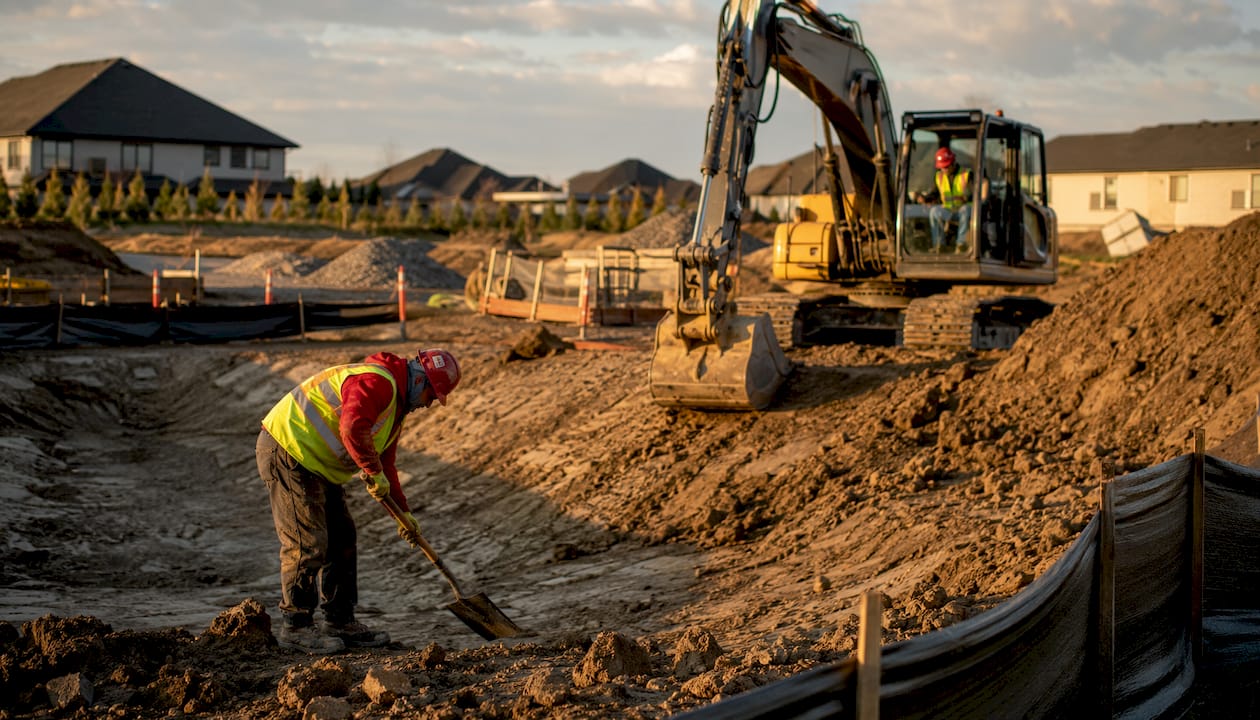
The most common field issue with dry detention basins is imperfect grading. A basin floor that does not drain positively to the low-orifice will hold shallow water for days after a storm. That standing water breeds mosquitoes, draws complaints, and creates a public-health problem the owner did not budget for. Specifying positive drainage to the outlet and verifying it during construction is not optional.
Outlet clogging is the second most consistent problem. Detention basins rely on precise outlet control structures, and minor clogs can cause immediate localized flooding during moderate storms. Trash racks, anti-clog orifice protection, and accessible outlet structures are worth every dollar at the design stage.
On the retention side, the most common mistake is under-budgeting O&M. Owners approve a wet pond because it satisfies the permit, then discover three years later that the forebay is full and the main pool is silting in. A wet pond without a funded maintenance program degrades quickly and can become a liability rather than an asset.
Barnhart Excavating approaches every pond project with a site assessment that covers grading, outlet placement, access for maintenance equipment, and a realistic O&M conversation with the owner before a shovel goes in the ground. That upfront coordination, combined with utility installation expertise for outlet piping and storm sewer connections, is what keeps these projects performing the way the permit requires.
Barnhart Excavating: experienced pond excavation and site grading from the ground up
Selecting the right pond type is only the first decision. Getting the excavation, grading, and outlet installation right is what determines whether the system actually performs.

Barnhart Excavating brings over 80 years of earthwork and utility experience to detention and retention pond projects across the region. From initial site grading and basin excavation to outlet structure installation, storm sewer connections, and concrete outfall stabilization, the team handles the full scope of pond construction work. Permitting coordination, phased construction scheduling, and clear communication throughout the project are part of every engagement, not extras.
If you are at the design stage and need a contractor who understands both the technical requirements and the practical realities of pond construction, request a site assessment from Barnhart Excavating’s earthwork team to get accurate scope and cost information before your engineer finalizes the design.
FAQ
Is a detention pond the same as a retention pond?
No. A detention pond drains completely after each storm and has no permanent pool, while a retention pond maintains a permanent pool year-round and provides ongoing water-quality treatment in addition to temporary surge storage.
What is the main functional difference between a detention basin and a retention basin?
A detention basin controls peak flow by temporarily storing runoff and releasing it at a controlled rate through a low-level orifice. A retention basin holds a permanent pool and treats stormwater through sedimentation and biological uptake, making it more effective for pollutant and nutrient removal.
Why does Florida have so many retention ponds?
Florida’s flat topography, high water table, and strict nutrient-removal requirements for its receiving waters make retention ponds the practical default for stormwater management. The permanent pool supports the water-quality treatment that state regulations require, and the shallow grades make dry drainage difficult to achieve.
When should you choose a detention pond over a retention pond?
Choose a detention basin when peak-flow control is the primary goal, the site is space-constrained, and your AHJ does not require water-quality volume credits. For sites under 10 acres, green infrastructure is often a better fit than either pond type.
What is the difference between a retention dam and a detention dam?
A retention dam holds water permanently, designed to store and treat runoff through infiltration, evaporation, or controlled release. A detention dam temporarily holds runoff and releases it at a controlled rate, with the basin returning to dry condition between storms.