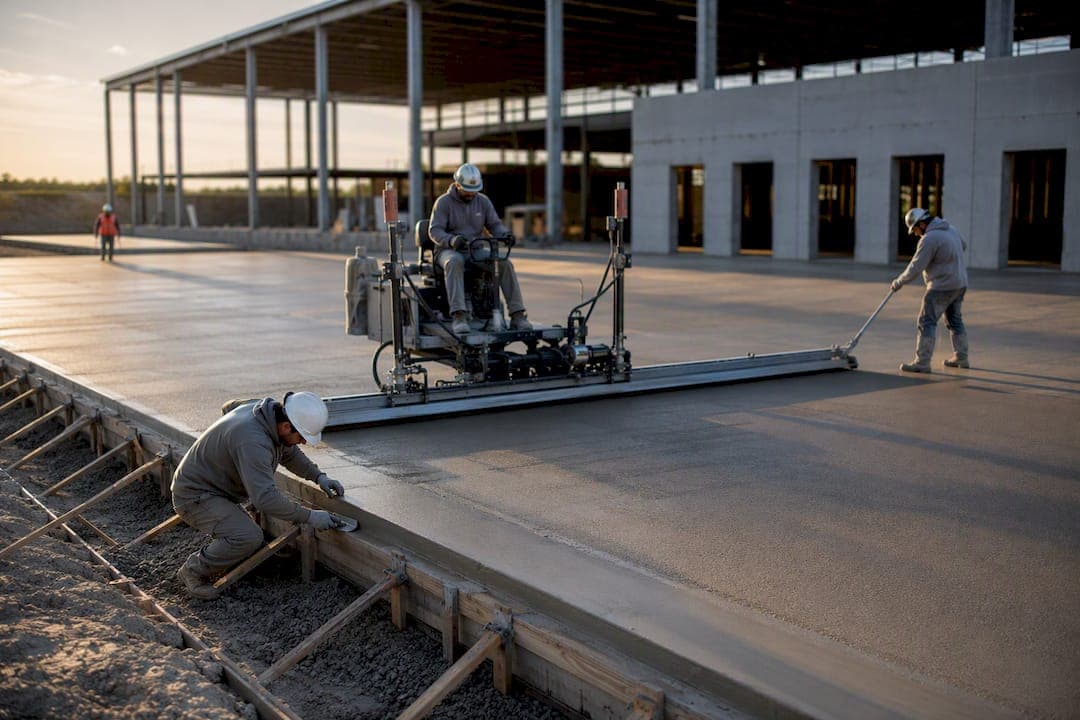
Commercial concrete flatwork can range from roughly $6 to $15 or more per square foot installed, depending on slab thickness, reinforcement, finish requirements, site access, and subgrade conditions. Basic flatwork may fall near the lower end, while reinforced industrial slabs and projects with difficult site conditions can cost considerably more. For developers, the square-foot price is only a starting point. The bigger budgeting question is what is actually included in that number.
TL;DR:
Most commercial slabs cost between $6 and $15 per square foot, with heavier reinforcement and finishes pushing prices toward the upper end.
Site conditions, especially poor soil bearing capacity and restricted urban access, can cause bids to significantly exceed initial estimates.
Properly assessing bid line items such as slab thickness, reinforcement type, base requirements, and pour assumptions prevents cost surprises.
Ready-mix pricing can change with material costs, market conditions, and delivery requirements, so older quotes should be verified before finalizing a project budget.
Transparent bids that clearly specify scope details and assumptions save money by reducing unexpected change orders.
Table of Contents
-
Where the Money Actually Goes: Materials, Labor, and Site Prep
-
What Actually Moves the Price: Thickness, Reinforcement, and Finish
-
How to Read a Commercial Flatwork Bid Without Getting Burned
-
What Barnhart Excavating’s Preconstruction Checklist Catches Before It Costs You
What Does Commercial Flatwork Cost Per Square Foot?
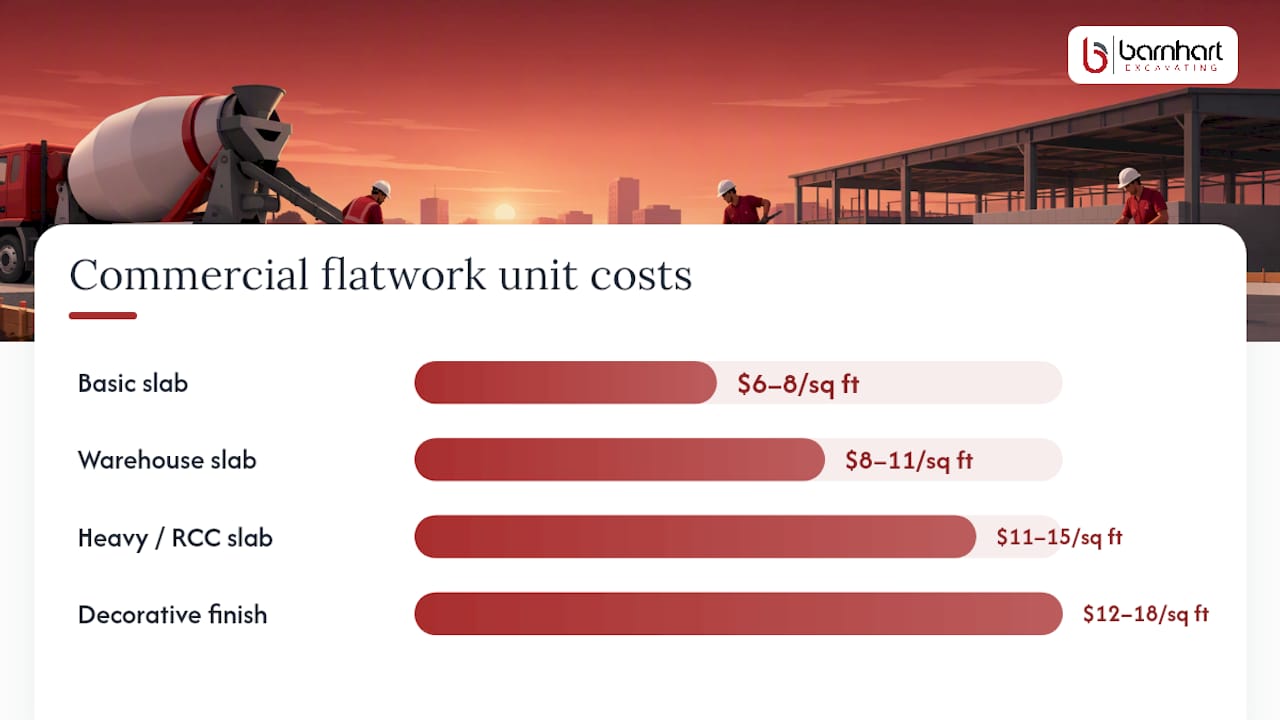
Unit pricing varies more by slab type than by geography, though both matter. Here’s how the ranges typically shake out for 2026 projects:
-
Basic commercial slab (sidewalks, light-duty parking, storage yards): $6 to $8 per square foot
-
Warehouse or industrial floor slab (standard reinforcement, moderate loading): $8 to $11 per square foot
-
Heavy-duty industrial slabs or reinforced concrete pavement for truck traffic or heavy equipment: $11 to $15+ per square foot
-
Decorative or polished finishes (retail lobbies, showroom floors): $12 to $18 per square foot depending on the treatment
At $9.50 per square foot, a 2,000-square-foot slab would carry a rough installed budget of about $19,000, while a 10,000-square-foot slab would be about $95,000. Those are budgeting examples only. Actual pricing can move substantially once slab design, reinforcement, earthwork, access, drainage, and subgrade requirements are known.
These figures assume normal access and average soil conditions. Sites with poor bearing capacity or tight urban access routinely blow past the high end before a single yard of concrete gets poured. The BLS Producer Price Index tracks changes in ready-mix concrete pricing over time, but actual delivered concrete costs vary by market, mix design, quantity, haul distance, and project schedule. That is why older supplier quotes should be verified before a project budget is finalized.
Where the Money Actually Goes: Materials, Labor, and Site Prep
Ready-mix concrete can commonly fall around $150 to $200 per cubic yard delivered, although local supplier pricing, mix design, quantity, haul distance, and surcharges can move that number considerably. A 4,000 psi mix with standard admixtures sits near the low end; add fiber reinforcement, accelerators for cold-weather pours, or a low-permeability mix for chemical exposure, and per-yard costs climb fast.
Site prep is where budgets actually break. The items that blow past initial estimates almost every time:
-
Proof-rolling and subgrade verification to confirm bearing capacity before any concrete gets ordered
-
Undercut and export of unsuitable soils, often the single largest surprise line item on a bid
-
Base material and compaction, with type, thickness, and density requirements determined by the project plans, specifications, loading conditions, and geotechnical recommendations
-
Soil stabilization, whether lime, cement, or geotextile-based, when the subgrade doesn’t meet bearing requirements
Placement method matters too. A pumped pour costs more per yard than a direct chute placement, but on a site with restricted access or a large footprint, the pump often pays for itself in labor hours saved. Staged pours, breaking a large slab into sections to manage joint placement and crew capacity, add cost but reduce cracking risk on bigger commercial floors.
What Actually Moves the Price: Thickness, Reinforcement, and Finish
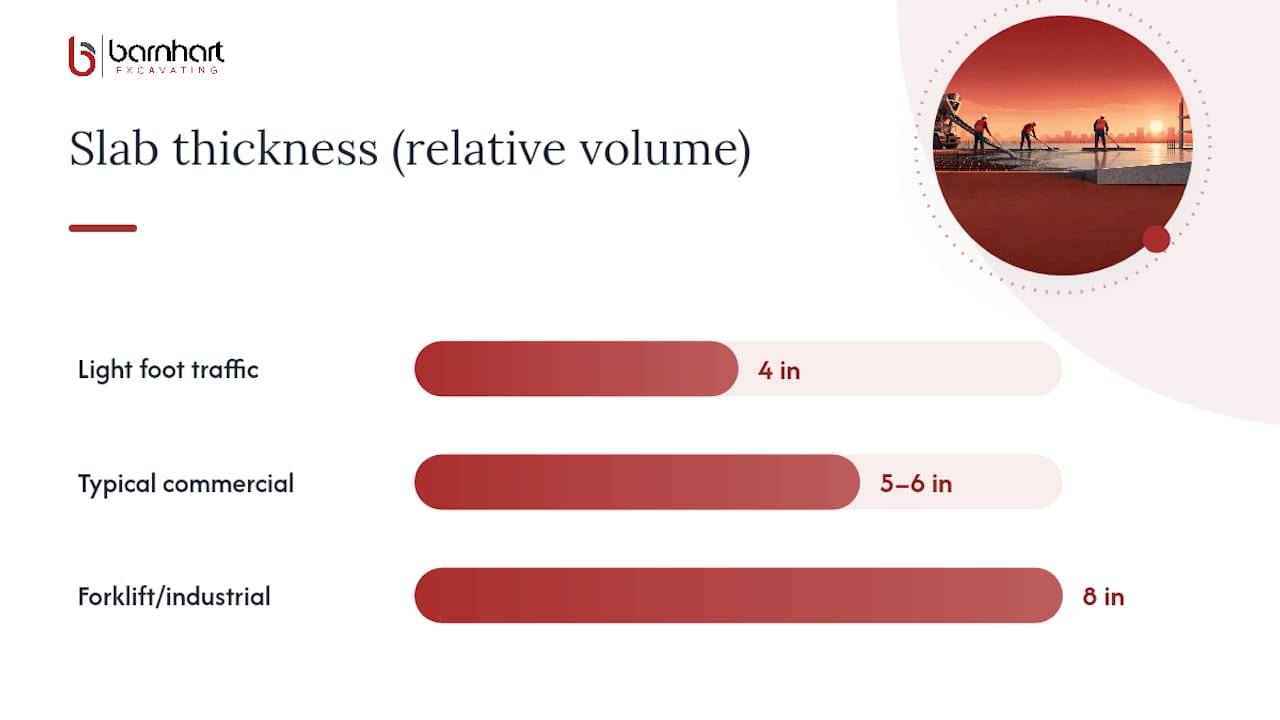
Slab thickness is the most direct driver of material cost because it scales concrete volume linearly. A 4-inch slab for light foot traffic uses roughly half the concrete of an 8-inch slab built for forklift and truck loading. Commercial slab thickness varies by use and design loading. Sidewalks and light-duty areas may require relatively thin sections, while warehouse floors, truck areas, loading zones, and industrial slabs may require substantially thicker sections based on the engineer’s design.
Reinforcement choice changes both material and labor cost:
-
Welded wire reinforcement is commonly used for crack control in certain slab applications and is generally less labor-intensive than a rebar grid
-
Rebar grids may be specified where the slab design requires greater reinforcement or load capacity
-
Post-tensioning may be used on certain large or specialized slabs where the structural design calls for it
Concrete strength (measured in psi) affects price on its own. A standard 3,500 psi mix costs less than a 4,500 or 5,000 psi mix used for heavy-load or freeze-thaw environments. Air entrainment and other admixtures add small per-yard costs but prevent much larger repair bills down the road.
Finish requirements deserve real attention in budgeting. Standard broom finishes cost little beyond base labor. Tight flatness and levelness tolerances for forklift or automated racking systems require laser screeds and more finishing time. Curing matters as much as placement. The FHWA’s guidance on curing compound timing makes clear that delayed or incomplete curing application raises the risk of shrinkage cracking, which turns into warranty callbacks and repair costs nobody budgeted for.
Pro Tip: Make sure bidders are pricing the same scope. Slab thickness, reinforcement, base preparation, testing, access, curing, and exclusions can make two similar-looking square-foot prices represent very different jobs.
Site access, weather windows, and permit or engineering fees round out the list. A tight urban site with one crane path costs more to pour than an open greenfield pad, even at identical square footage.
How to Read a Commercial Flatwork Bid Without Getting Burned
Two bids quoting the same per-square-foot price can represent wildly different scopes. Leveling them fairly means normalizing for the same variables every time:
-
Slab thickness and psi stated explicitly, not assumed from “standard commercial spec”
-
Reinforcement type and spacing (mesh gauge, rebar size, or post-tension cable layout)
-
Base type and thickness, plus who’s responsible for compaction testing
-
Vapor barrier requirements, particularly for interior slabs that will receive moisture-sensitive flooring or finishes
-
Finish and flatness tolerances, especially for racking or automated equipment
-
Saw-cut timing and joint layout, curing method, and testing responsibilities
Watch for vague allowances buried in the fine print. Common exclusions that surface as change orders later include soil export beyond a stated depth, utility sleeve installation, traffic control on active sites, and winter protection measures for cold-weather pours. If a bid doesn’t address these items explicitly, clarify them before awarding the work.
Request the ready-mix quote date, minimum load quantities, and any escalation language tied to material price increases. A bid based on an older ready-mix quote can shift by the time concrete is ordered, especially when supplier pricing or project timing changes. The clearest fix: ask bidders to break out unit costs by line item rather than a single blended number, so you can compare apples to apples across proposals.
What Barnhart Excavating’s Preconstruction Checklist Catches Before It Costs You
Before commercial flatwork begins, the concrete scope needs to be coordinated with the work underneath and around it. That includes final grades, subgrade condition, base material, underground utilities, sleeves and embeds, drainage, testing requirements, access, and the planned pour sequence.
From the civil contractor side, many expensive concrete problems actually start before concrete arrives. Soft subgrade, incorrect elevations, unresolved utility conflicts, or poor access can delay placement and create additional excavation, base, or concrete work. Addressing those conditions during site preparation is usually easier and less expensive than dealing with them after forms and reinforcement are in place.
Pro Tip: If a bid seems unusually low, compare the assumptions behind it. Subgrade preparation, access, base material, reinforcement, testing, and exclusions are common places where scopes differ.
Why Most Cost Estimates Miss the Real Risk
The conventional advice on commercial flatwork pricing focuses almost entirely on the per-square-foot number, and that’s backwards. A $9 per square foot bid built on unrealistic pour-rate assumptions or a hidden exclusion for soil export will cost more than a $10.50 bid that names every variable up front. The FHWA’s life-cycle cost framework makes the same point about durability choices: the lowest initial number rarely wins once you count what happens after the pour.
The bigger risk is often what the unit price leaves out. Subgrade repair, unsuitable soil export, additional base, restricted access, utility conflicts, testing, or changes in slab design can move the final cost far more than a small difference in the original square-foot price. A useful estimate should identify those assumptions early so the owner understands both the expected cost and the conditions that could change it.
Getting an Accurate Flatwork Estimate for Your Site
Barnhart Excavating performs commercial concrete work alongside earthwork, grading, site development, and underground utility construction in Oklahoma. Having those scopes coordinated early helps identify issues involving subgrade, elevations, drainage, utility crossings, access, and concrete placement before they become field conflicts.
For an accurate commercial concrete estimate, provide the project plans, available geotechnical information, concrete specifications, reinforcement requirements, finish requirements, and target schedule. Barnhart can review the concrete scope along with the surrounding civil site work to identify the conditions that may affect pricing.
Sources
FAQ
How much does it cost to pour a 40×60 concrete slab?
A 40×60 slab contains 2,400 square feet. At a rough commercial budgeting range of $6 to $15 per square foot, that would equal approximately $14,400 to $36,000. Actual cost depends on slab thickness, reinforcement, subgrade preparation, access, finish requirements, and local concrete pricing.
How much does a 2,000 square foot concrete slab cost?
At a rough commercial budgeting range of $8 to $11 per square foot, a 2,000-square-foot concrete slab would cost approximately $16,000 to $22,000 installed. Site preparation, reinforcement, slab thickness, finish requirements, and access can move the final price higher or lower.
How much does a 30×50 concrete slab cost?
A 30×50 slab contains 1,500 square feet. At a rough budgeting range of $6 to $11 per square foot, that equals approximately $9,000 to $16,500 installed. Subgrade conditions, reinforcement, thickness, and site access can significantly affect the final cost.
How much does it cost to pour a 20×40 concrete slab?
A 20×40 slab contains 800 square feet. At a rough budgeting range of $6 to $8 per square foot, that equals approximately $4,800 to $6,400 installed for straightforward flatwork. Smaller pours can carry higher unit costs because mobilization, forming, finishing, and delivery costs are spread across less square footage.
What information does a contractor need to price commercial concrete flatwork?
A commercial concrete contractor will typically need project plans, slab dimensions and thickness, concrete strength, reinforcement requirements, finish specifications, site access information, subgrade or geotechnical information, and the anticipated construction schedule. The clearer the scope is before bidding, the easier it is to compare proposals accurately.