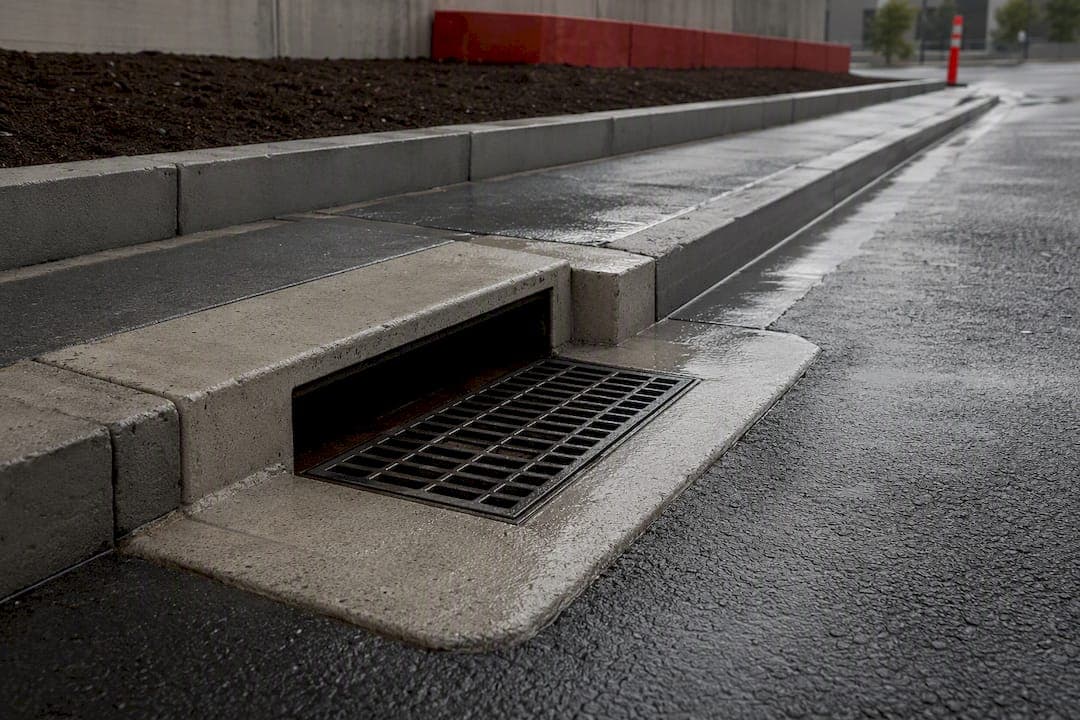
Storm drain inlets fall into four primary classes: curb-opening, grate, combination, and linear (slotted or trench). Choice depends on grade, debris load, and whether the inlet sits in a sump or on continuous grade. Drop inlets, manhole inlets, and deck drains round out the toolkit for ditches, medians, and bridges. Sags and debris-prone spots favor curb or combination inlets; steep, continuous grades often call for grates or slotted drains.
TL;DR:
Curb-opening inlets work best in sag locations with debris, but struggle on steep grades where fast-moving flow bypasses them.
Grate inlets are suitable for continuous grades and areas prone to clogging, but require debris reduction factors to account for trash buildup.
Combination inlets improve reliability by capturing flow with both curb openings and grates but increase maintenance complexity.
Proper installation sequencing and matching inlet dimensions with standard plates are critical to prevent long-term ponding and settlement issues.
Applying a clogging reduction factor during sizing ensures inlets maintain capacity during actual storm debris loads.
Table of Contents
-
Combination Inlets: Why Pairing Curb and Grate Adds Reliability
-
Linear, Slotted, and Trench Drains: When Continuous Capture Wins
-
Drop, Pipe, and Manhole Inlets: Structural and Off-Road Roles
-
Maintenance and Selection Checklist for Designers and Contractors
Storm Drain Inlet Types and Hydraulic Conditions
Storm drain inlets are generally selected based on both their physical configuration and the conditions where they will collect runoff. Common inlet types include grate inlets, curb opening inlets, combination inlets, and slotted drains.
Another important distinction is whether an inlet is located at a low point, or sump, where runoff collects, or along a continuous grade where water is moving past the inlet. That condition affects how much runoff the inlet needs to capture and how much bypass flow may continue downstream.
Because inlet names, dimensions, and standard details vary by agency, designers and contractors should always work from the plans and the current standards for the governing municipality or DOT. In Oklahoma,Oklahoma Department of Transportation (ODOT)'s Roadway Drainage Manual identifies grate, curb opening, slotted drain, and combination inlet configurations and directs designers to the current ODOT roadway standard drawings for accepted inlet types.
Curb-Opening Inlets: Weir Behavior and Best Applications
A curb-opening inlet is a vertical throat cut into the curb face, usually paired with a depressed gutter section to concentrate flow toward the opening. In a sump condition, it behaves as a weir, meaning capacity scales with the length of the opening and the depth of ponding against the curb, not with the grate area. The Round Rock drainage manual walks through the weir equation form used for sizing these openings in sag locations.
Curb inlets earn their reputation as the workhorse choice for a specific reason:
-
Debris passes over them, not into them. Leaves and trash tend to float past a curb opening rather than clog it, unlike a grate lying flat in the flow path.
-
They carry no bicycle or pedestrian hazard. No bars, no wheel-catching slots, no ADA complications at crosswalks.
-
They struggle on steep grades. Water moving fast along a steep gutter can shoot past a curb opening without dropping in, which is why grates or combination inlets often take over on continuous grades above a few percent.
Pro Tip: A depressed gutter section can improve capture at a curb inlet, but the depression depth and inlet geometry should follow the approved plans and the applicable municipal or DOT standard detail.
Always confirm throat length and depression depth against your local standard plate. The TxDOT Hydraulic Design Manual shows how these dimensions shift capacity substantially between adjacent jurisdictions.
Grate Inlets: Interception Efficiency and Clogging Risk
Grate inlets intercept flow through openings in a flat or slightly sloped surface set into the gutter or pavement. Capacity depends on two separate mechanisms: frontal flow interception, where water flows directly into the grate as it travels downstream, and side flow interception, where water splashes in laterally as it crosses the grate width. Bar orientation changes both. Parallel bars aligned with flow pass more water through frontal openings; a reticuline or honeycomb pattern trades some frontal efficiency for better debris resistance.
Grates fit naturally into these situations:
-
Continuous grades where curb openings would be overrun by fast-moving sheet flow.
-
Median ditches and swales where there is no curb face to cut into.
-
Locations where a flush surface is required, such as parking lot travel lanes.
Grate capacity can be reduced significantly when leaves, gravel, trash, or construction sediment cover part of the opening. Hydraulic design guidance commonly accounts for that loss of effective inlet area rather than assuming the grate will remain completely clear during a storm.
Where bicycle traffic shares the roadway, grate bar spacing has to meet bicycle-safe standards, and structural loading has to account for traffic wheel loads per your local DOT’s frame and grate tables, per SDDOT Chapter 12.
Combination Inlets: Why Pairing Curb and Grate Adds Reliability
A combination inlet places a grate and a curb opening at the same location, typically with the grate positioned in the gutter and the curb opening either adjacent or slightly upstream as a sweeper. The two components don’t simply add their capacities in a straight line; the curb opening picks up carryover flow that skips past the grate, which is exactly why combination inlets outperform either type alone in a sag.
Common layouts include:
-
Adjacent curb and grate, sharing one structure and one outlet pipe.
-
Sweeper configuration, where the curb opening trails the grate to catch bypass flow before it clears the inlet zone.
-
Upstream curb inlet, placed slightly ahead of the grate to intercept debris before it reaches the grate bars.
The tradeoff is maintenance complexity: two capture mechanisms mean two things to inspect, and a clogged grate can quietly push its full design load onto the curb opening without anyone noticing until a storm exposes it.
Linear, Slotted, and Trench Drains: When Continuous Capture Wins
Slotted drains use a narrow continuous opening running parallel to flow, feeding a pipe or channel below grade. Vertical riser slot and vane-type configurations change how water enters, but both work best on minimal horizontal slope, where a point inlet would need to be spaced too tightly to be practical. Trench drains, the heavier-duty cousin, use a grated channel body instead of a slotted lid and handle higher flows but come with tighter depth constraints.
-
Flat medians and superelevation transition zones, where crown direction reverses and a single point inlet can’t catch flow from both sides.
-
Large parking lots and loading docks, where a continuous line drain avoids scattering multiple point inlets across a paved surface.
-
Bridge approach slabs and other geometries where a curb face doesn’t exist to host a curb-opening inlet.
Drop, Pipe, and Manhole Inlets: Structural and Off-Road Roles
Drop inlets and pipe inlets serve locations without a paved gutter to work from: roadside ditches, median swales, and yard drains around buildings. They function as vertical structures that accept flow from the surface and drop it into a buried pipe network, often built with a simple grated top rather than a curb throat or slotted lid.
-
Manhole-type inlets double as access points for inspection and cleanout, not just capture structures.
-
Bridge deck drains and scuppers handle a narrow, specialized job: getting deck runoff off the structure before it reaches expansion joints or bearings.
-
Frame, grate, and riser components need to be rated for the traffic loading of their location, whether that’s a parking lot drive aisle or a highway shoulder.
Coordinate riser height carefully with final grade. A drop inlet set too high can interfere with drainage or create a surface hazard; set too low, it can collect sediment.
Inlet Location and Spacing: Controlling Spread and Ponding
Spacing calculations tie directly back to allowable spread, the maximum width of ponded water a design permits along the gutter before it starts intruding on travel lanes. The TxDOT design criteria sets spread limits based on gutter cross slope, longitudinal slope, pavement roughness, and design discharge, and every inlet’s placement gets checked against that limit rather than against a fixed distance rule.
Three placement rules carry the most practical weight on real projects:
-
Keep inlets outside through lanes whenever geometry allows. An inlet structure in a travel lane creates a maintenance hazard and a pavement joint that fails faster under wheel loading.
-
Consider supplemental or flanking inlets at major sag points where the governing design criteria calls for additional capacity or redundancy.
-
Use recessed inlets in high-flow gutters to pull the capture point slightly off the main flow line, reducing splash-over during peak intensity storms.
Spacing between on-grade inlets comes down to running the interception efficiency curve for your chosen inlet against the accumulating gutter flow, then setting the next inlet wherever spread would otherwise exceed the allowable limit. For sites where the storm sewer system ties into a detention or retention basin, see our Guide to detention vs. retention ponds.
How Inlet Capacity Is Evaluated
Hydraulic designers typically evaluate inlet capacity using two equation families. Curb-opening inlets in sumps use weir-form equations, where capacity is a function of opening length and ponding depth. Grate inlets, once submerged, transition to orifice behavior, where capacity depends on open area and head. The Round Rock drainage manual works through both forms with worked examples that are worth having open next to your own calculations rather than trusting memory.
Design guidance commonly includes reductions or allowances for partial clogging rather than assuming an inlet will remain completely clear during a storm. Grates typically need a larger reduction than curb openings, since flat grate surfaces trap leaves and gravel far more readily than a vertical throat.
Common practical steps:
-
Pull the interception efficiency curve or figure for your exact inlet type from the applicable state manual rather than approximating from a generic chart.
-
The applicable design manual may require an allowance or reduction for clogging. Undersizing capacity is the safe direction; loosening spread limits is not.
-
Cross-check calculated throat length, grate area, or slot width against available castings and the applicable standard details early so the specified inlet can be procured and installed as designed.
Assuming an inlet will remain completely clear can overstate its real-world capacity once leaves, trash, gravel, or construction sediment reach the structure. Treat the reduction factor as a design input, not an afterthought applied during a value-engineering review.
Maintenance and Selection Checklist for Designers and Contractors
Specifying the right inlet on paper only pays off if the structure stays functional for decades, not just through the first wet season.
-
Specify removable grates and accessible cleanouts wherever slotted or trench drains are used, since siltation is a certainty over time, not a possibility.
-
Consider supplemental or flanking inlets at major sag points where the governing design criteria calls for additional capacity or redundancy.
-
Where the plans and site geometry allow, locating structures outside primary wheel paths can reduce conflicts with traffic and future maintenance.
-
Confirm debris storage capacity at the inlet sump, especially near tree cover or gravel drive entrances.
Pro Tip: Match inlet type to the three site variables that actually drive failure in the field: longitudinal grade, debris source (trees, gravel lots, construction sediment), and bicycle or pedestrian presence.
For commercial sites, drainage structures also have to be coordinated with subgrade, paving, and final elevations throughout parking lot construction.
What Field Experience Teaches About Inlet Installation
From the contractor side, inlet performance depends on more than selecting the right structure on a plan. Elevation, grading, pipe connections, curb placement, and the sequence of the work all matter once construction starts.
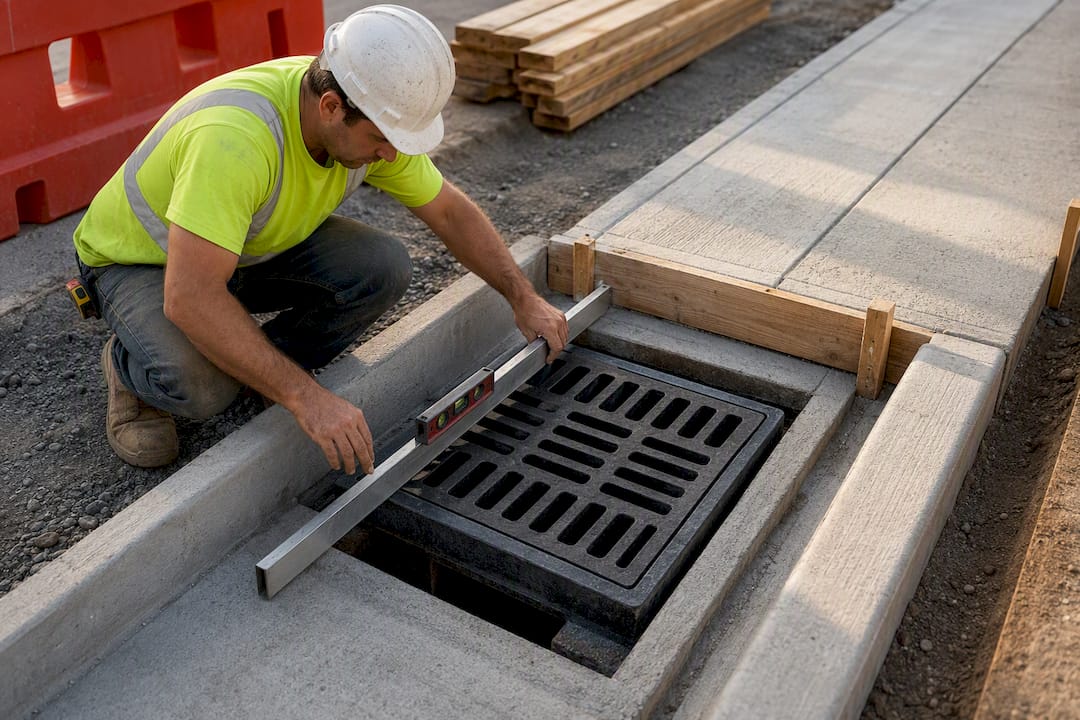
One of the biggest field considerations is verifying the inlet and frame elevation against the approved plans and finished grade before the surrounding curb, gutter, or pavement is completed. A structure that is set too high can leave water standing around it. Set too low, it can collect sediment or create an unwanted depression.
That is why storm sewer installation has to stay coordinated with grading and concrete work. The pipe, structure, subgrade, curb, and final surface all need to finish at elevations that work together.
Where to Find Standard Plates and Capacity Curves
The manuals referenced throughout this guide, including TxDOT’s Hydraulic Design Manual, the MDOT Drainage Manual, and applicable Oklahoma ODOT standards, provide capacity curves, design criteria, and other guidance referenced in this article. None of them substitute for your local standard plates, which set exact throat lengths, grate castings, and frame dimensions. Review Barnhart Excavating’s completed projects for examples of inlet and storm sewer work carried through from design to final grade.
The Gap Between Manual Language and Site Reality
A drainage plan can show the correct inlet type and elevation, but the field still has to make all of the surrounding pieces work together.
Existing utilities can affect structure placement. Subgrade conditions can change how an inlet or pipe run is built. Curb and pavement elevations have to meet the structure correctly. Construction sediment also has to be managed so a newly installed inlet does not become the collection point for material washing across an unfinished site.
That is where coordination between the designer, surveyor, general contractor, and civil contractor matters. When something in the field does not match the plans, it is better to identify it before the structure is set and the surrounding concrete or pavement is complete.
The drawing tells you what needs to be built. Good field coordination is what gets it there.
Get Storm Drain Inlets Installed Right the First Time
Choosing the correct inlet is a design decision, but successful installation depends on getting the structure, pipe, grading, and surrounding improvements to work together in the field.

Barnhart Excavating performs underground utility and civil site work throughout Oklahoma, including storm sewer systems, drainage structures and inlets, manholes, earthwork, grading, and concrete. Our crews work from the approved plans, standard details, and project elevations to coordinate the underground work with the rest of the site.
For commercial, municipal, and public infrastructure projects, learn more about Barnhart Excavating’s underground utility installation services.
Sources
FAQ
What Are the Three Main Types of Storm Drain Inlets?
Most manuals group inlets into curb-opening, grate, and combination types, with linear or slotted drains treated as a fourth specialized class for flat or continuous-capture geometries, as outlined in the TxDOT Hydraulic Design Manual.
What Is a Type C Storm Inlet?
Type designations vary by jurisdiction, so a Type C inlet in one state’s standard plates may describe a different geometry than a Type C in another. Always confirm the exact dimensions against your local standard plate rather than assuming label equivalence.
What Is the Difference Between a Sump Inlet and an On-Grade Inlet?
Some drainage manuals distinguish between inlets located in a sump and inlets located on grade because the hydraulic conditions are different. In a sump, runoff collects at the low point. On grade, some flow may bypass the inlet and continue downstream.
What Are Type B Inlets?
Type B is another jurisdiction-specific designation found on many state standard plates, typically referring to a particular curb-opening or grate geometry. It does not have one universal definition, so check the issuing agency’s plate before specifying it.
How Do I Choose the Right Storm Drain Inlet Type for a Site?
Match inlet choice to three variables: longitudinal grade, debris exposure, and pedestrian or bicycle presence. Sags and debris-heavy areas favor curb or combination inlets, while continuous grades often call for grates or slotted drains with the appropriate clogging reduction applied.