
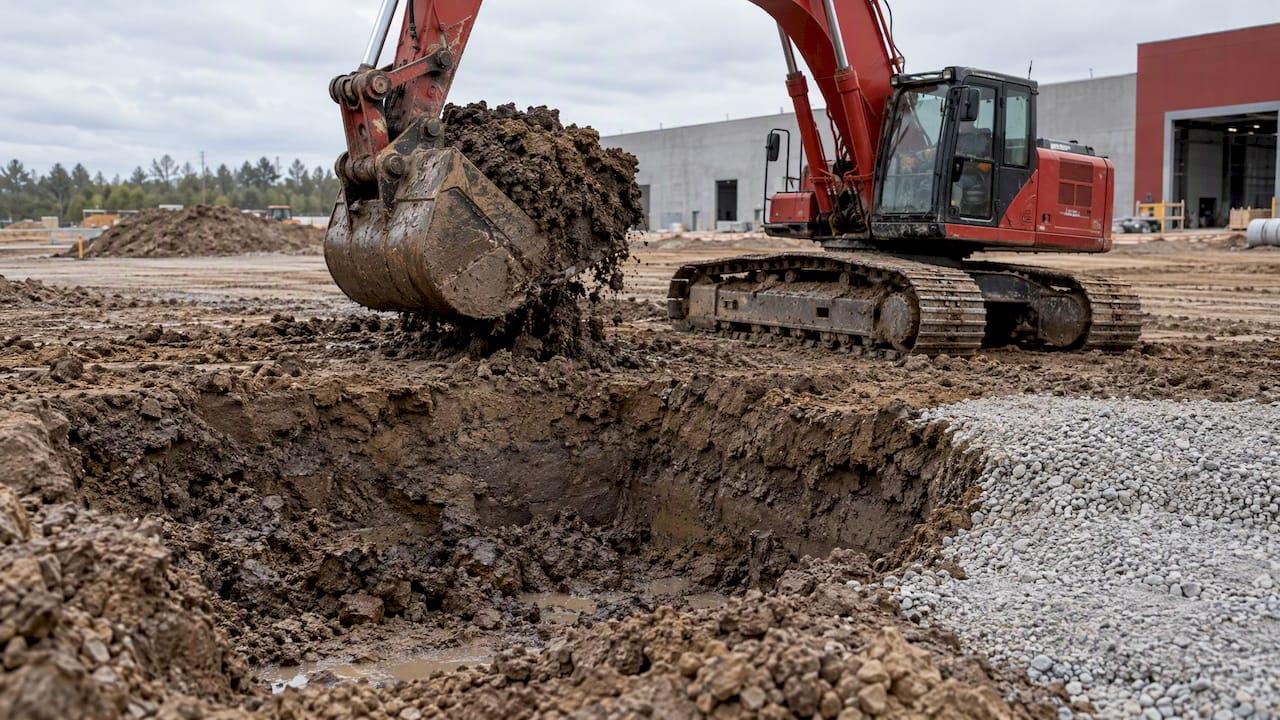
Undercut and backfill is the process of digging out soil that cannot carry the load above it, hauling it away, and replacing it with approved, compacted material. It happens under building pads, roads, parking lots and utility trenches whenever the ground you have is not the ground the design assumes. Done well, it is invisible once the project is finished. Done poorly, it shows up later as settlement, cracked slabs and failed pavement.
This guide explains what undercut means, how unsuitable soil is identified, how replacement fill is placed and tested, and why the process matters for commercial construction. At Barnhart Excavating, we provide earthwork and underground utility services throughout the Tulsa area and surrounding Oklahoma communities.
Table of Contents
What undercut means in construction
An undercut is an excavation below the planned subgrade elevation to remove material that will not perform. One municipal specification defines it as removing material the engineer determines unsuitable and replacing it with specified select borrow, including compaction at the location and depth the engineer directs.
That definition carries three ideas worth keeping in mind:
-
The limits of unsuitable material should be established or approved by the project engineer or geotechnical engineer. The contractor performs the excavation according to the approved direction and project requirements.
-
Unsuitable material must be handled according to the project specifications. Depending on its condition and the engineer’s direction, material may require off-site disposal, treatment, or another approved use.
-
The replacement is specified. The material, the layer thickness, the density and the moisture all come from the project documents.
Typical reasons for an undercut include soft or pumping clay, organic topsoil or muck left under a planned pad, buried debris, old fill of unknown quality, and soil that has been softened by water during construction.
Undercut, backfill and fill: what is the difference?
The words overlap in casual talk, but plans and specifications use them differently.
-
Fill raises part of the site to a designed line and grade. One public works specification describes it as material that raises the level of a portion of the site, while backfill refills an excavation.
-
Backfill returns material to a hole you dug, whether that is a utility trench, a foundation excavation or an undercut.
-
Undercut is the removal step that comes before the replacement backfill.
The Federal Highway Administration describes fill as earthen material commonly spread in 6- to 8-inch layers and compacted by rolling, with coarser material normally placed near the base for foundation and drainage and higher-quality compacted material near the top.
USDA’s Natural Resources Conservation Service draws another line based on where the work happens. Earthfill is placed and compacted conventionally, while earth backfill goes into confined spaces or beside structures and pipes, using hand tampers, manually directed power tampers, vibrating plates or equivalent equipment. That distinction matters for cost and schedule, because confined backfill is slower than open fill.
How crews find the soil that has to go
Geotechnical investigations provide valuable information about soil conditions before construction begins. However, additional unsuitable areas may become apparent once excavation is underway and the subgrade is exposed.
One common field evaluation method is proof-rolling, which involves moving appropriately loaded equipment across the prepared subgrade to identify areas showing excessive movement, rutting, or instability. Soft spots rut, pump or deflect under the load, and those areas get flagged for the engineer.

The engineer’s role is well defined on public work. Caltrans’ construction manual directs the resident engineer to examine natural ground, identify removal areas and depths, and record quantities and payment treatment. The engineer also inspects the exposed area, decides on drainage or corrective action before backfilling, advises on suitable backfill and observes compliance.
Private projects follow the same logic even when the paperwork is lighter. Someone qualified, usually the geotechnical engineer of record, should walk the exposed subgrade and set the limits in writing. Agreeing on those limits before the equipment moves is the best way to avoid arguments over quantities later.
When the soil is weak but not bad enough to remove, undercutting is not the only answer. Lime, cement or geosynthetic stabilization can be cheaper than hauling soil off and importing fill. We cover how contractors weigh those options in our guide to subgrade stabilization methods.
The undercut and backfill process, step by step
The sequence below reflects how the specifications cited here describe the work. Your project documents control the details.
-
Locate utilities and set up protection. Underground utilities must be located before excavation begins, and the excavation needs the safety measures covered later in this article.
-
Strip and mark the limits. Survey or GPS machine control marks the horizontal limits and the finished subgrade elevation so the removal depth is measured, not eyeballed.
-
Excavate the unsuitable material. Dig to the depth the engineer directs. Keep the excavation dry and avoid disturbing the soil below the cut.
-
Inspect the exposed bottom. The engineer or testing technician checks the firm material. If it is still soft, the cut goes deeper or the engineer chooses another corrective action.
-
Handle unsuitable material. Removed soil is hauled, disposed of, or otherwise managed in accordance with the project’s specifications and approved disposal requirements.
-
Place replacement fill in uniform layers. Each layer is spread at a controlled thickness, moisture-conditioned and compacted before the next goes on.
-
Test and correct. Density tests confirm the result. Anything that fails gets reworked.
-
Proceed to the next phase. Once the required inspections, testing, and approvals are complete, work can proceed with the next phase of construction.
The Chesapeake document puts the last two steps plainly: the city may perform compaction tests, and the contractor must correct noncompliant backfill. Plan for retests in your schedule.
Choosing backfill material
Not every soil makes good backfill. A Cape Fear Public Utility Authority specification says satisfactory soils must be free of debris, organic matter, waste, frozen materials, muck, roots, vegetation and other deleterious matter. The same specification prohibits placing or compacting fill where standing water is present, or in a frozen condition or on frozen material, and requires unacceptable fill to be removed and replaced with approved material.
Suitability also depends on how the soil behaves. NRCS explains that permeability, strength, compressibility, workability, particle size and fines content all affect whether a material suits a given use.
In practice, the choice comes down to the job the fill has to do:
| Use | What matters most | Typical direction |
|---|---|---|
| Under a building pad or slab | Strength, low compressibility | Engineered select fill specified by the geotechnical engineer |
| Under pavement or parking | Stability, uniform support | Material meeting the pavement design’s subgrade requirements |
| Beside walls or structures | Drainage, low pressure on the wall | Free-draining material placed in controlled layers |
| Utility trench | Bedding support, no damage to pipe | Bedding and backfill as specified for the pipe type |
The table is a general orientation. The project’s specification names the actual material, and substituting a cheaper on-site soil without engineer approval is how failed backfill starts.
Replacement material requirements vary depending on soil conditions, structural loads, and project specifications. Contractors should follow the material requirements established for each project rather than applying standards from unrelated jurisdictions.
Does backfill need to be compacted?
Yes. Uncompacted backfill settles, and settlement is what damages slabs, pavement and pipes.
Compaction targets are written as a percentage of the soil’s maximum dry density from a laboratory test, at a moisture content near the optimum. Two public specifications show how the numbers vary:
| Specification | Layer thickness | Density target | Moisture |
|---|---|---|---|
| City of Chesapeake undercut | Uniform layers | At least 95% of theoretical maximum density | Within plus or minus 20% of optimum |
| Cape Fear utility authority, 2026 | Loose layers no more than 8 inches | 90% of maximum density under AASHTO T-180 | At optimum moisture content |
Differences in compaction requirements reflect the type of construction, material properties, testing methods, and project specifications. The required density and acceptable moisture range should be established by the project’s governing documents and verified through the appropriate testing procedures.
Three practical points follow from this:
-
Thin lifts compact better. Thick layers leave soft zones at the bottom that the roller never reaches.
-
Moisture is a tool. Fill that is too wet pumps and too dry will not densify. Crews add water or let the material dry as needed.
-
Test sections save rework. The Cape Fear specification requires moisture conditioning, suitable compaction equipment and a test section to verify the equipment and lift procedure before full production.
Working near foundations and keeping water out
Backfilling next to foundations and retaining walls requires additional care. Heavy compaction equipment, improper drainage, and unsuitable backfill can place additional pressure on structures and contribute to long-term performance problems.
The Cape Fear specification calls for lightweight or hand-operated compaction equipment within 10 feet of a completed below-grade wall. Compaction equipment generally needs to be matched to the fill type, and restricted areas call for smaller tools to prevent damage. Smaller tools mean thinner lifts and more labor hours, which is why this area belongs in the schedule and the price from day one.
Water needs equal attention. The same specification requires that excavations stay dry during work, subgrade preparation and backfilling, and that soil softened or eroded by water be removed and replaced with suitable backfill. A heavy Oklahoma rain on an open undercut can turn a one-day fix into a two-day one, so crews cover or pump the excavation and grade surface water away from it. Our guide to erosion control for construction covers the surface-water side.
Safety and inspection in open excavations
An undercut is an excavation, and excavation rules apply. OSHA’s trenching guidance says protection by sloping, benching, support systems or shields is required where employees face cave-in hazards. Underground utilities must be located before digging, and excavated material must be kept at least 2 feet from the edge or otherwise retained.
The same publication requires a competent person to inspect the excavation, adjacent areas and protective systems before work starts, daily and as needed during the shift, and after rainstorms or other hazard-increasing events. Workers must be removed from an unsafe area until precautions are in place. After a storm, an undercut that was fine yesterday may not be today. For a deeper look at the rules supervisors have to follow, see our piece on trench excavation safety.
Our perspective: where undercut work goes wrong
Barnhart Excavating is built on four generations of construction experience, and we understand that successful earthwork involves more than moving dirt. Clear communication, planning, and coordination are just as important as the work happening in the field.
Undercut work can become complicated when excavation limits are unclear, unexpected soil conditions affect quantities, or weather disrupts the schedule. Addressing these challenges requires coordination between the contractor, engineer, and project owner. Establishing clear expectations and communicating changes early can help prevent unnecessary confusion and delays.
At Barnhart Excavating, we believe straightforward communication is essential to a successful project. Using project plans, GPS machine control, and coordination with the project team helps us approach earthwork with accuracy and accountability. When unexpected conditions arise, communicating those challenges early allows everyone involved to make informed decisions and keep the project moving forward.
We also believe the cheapest-looking fix is often not the cheapest. Backfill that skips testing saves a day and risks a repair that costs far more than that day.
What undercut means for your budget and schedule
Undercut quantities can be difficult to predict before excavation begins. Depending on the contract, unforeseen undercut work may be addressed through unit pricing, allowances, or an approved change order. Understanding how additional work will be measured and documented is important for managing project costs. A few practical considerations can help reduce surprises:
-
Ask for geotechnical data early. Borings and the geotechnical report tell you where soft zones are likely.
-
Define the measurement method. Agree how cubic yards of removal and replacement are measured and who verifies them.
-
Account for disposal. Hauling and disposing of unsuitable soil, including any permits, is part of the cost, as the public specifications above make clear.
-
Account for weather delays. Rainfall and changing moisture conditions can affect excavation, soil stability, compaction, and testing schedules.
-
Coordinate with the pad and pavement work. Parking areas and drives depend on stable subgrade; our parking lot construction guide shows how subgrade fits into the whole sequence.
Site drainage features also depend on the earthwork beneath them. Basins and ponds are excavated and shaped as part of the same dirt package, as we explain in detention vs retention pond, and storm structures need well-compacted bedding, as covered in our article on storm drain inlet types.
Earthwork and site preparation in Oklahoma
Barnhart Excavating provides commercial earthwork, site grading, excavation, underground utility installation, and concrete services throughout the Tulsa area and surrounding Oklahoma communities. Our experience across multiple phases of site development helps us understand how early earthwork decisions affect the construction that follows.
If you have a site with questionable soils, a pad that needs to be built, or a bid package that includes undercut, talk to us about our earthwork services. Utility trenches, manholes and storm systems are handled through our utility installation team.

Planning a commercial construction project? Contact Barnhart Excavating to discuss your project, share available plans, and learn more about our earthwork and site development services.
FAQ
What is the difference between undercut and excavation?
Excavation is the general term for digging. Undercut is a specific kind of excavation that goes below the planned subgrade to remove material the engineer has judged unsuitable. It is almost always followed by replacement with specified, compacted fill.
Does backfill need to be compacted?
Yes. Specifications require backfill to be placed in uniform layers and compacted to a set percentage of maximum density, with testing to verify it. Examples in public specifications range from 90% to 95%, depending on the owner and the use, so follow your project’s own requirements.
What is the difference between backfill and fill?
Fill raises an area to a designed grade, while backfill refills an excavation such as a trench, foundation hole or undercut. Backfill beside structures and pipes usually has to be placed with smaller equipment in confined spaces.
Who decides how deep an undercut goes?
On specified work, the engineer sets the location and depth of removal, often after proof-rolling reveals unstable areas. On private projects, that is usually the geotechnical engineer of record. The contractor then excavates to those limits and documents quantities.
Can I reuse the soil I dig out as backfill?
Only if it meets the specification. Soil containing organic matter, debris, roots or muck is not satisfactory, and soil that is too wet may need drying or conditioning first. Material that was removed as unsuitable generally leaves the site rather than returning to the hole.